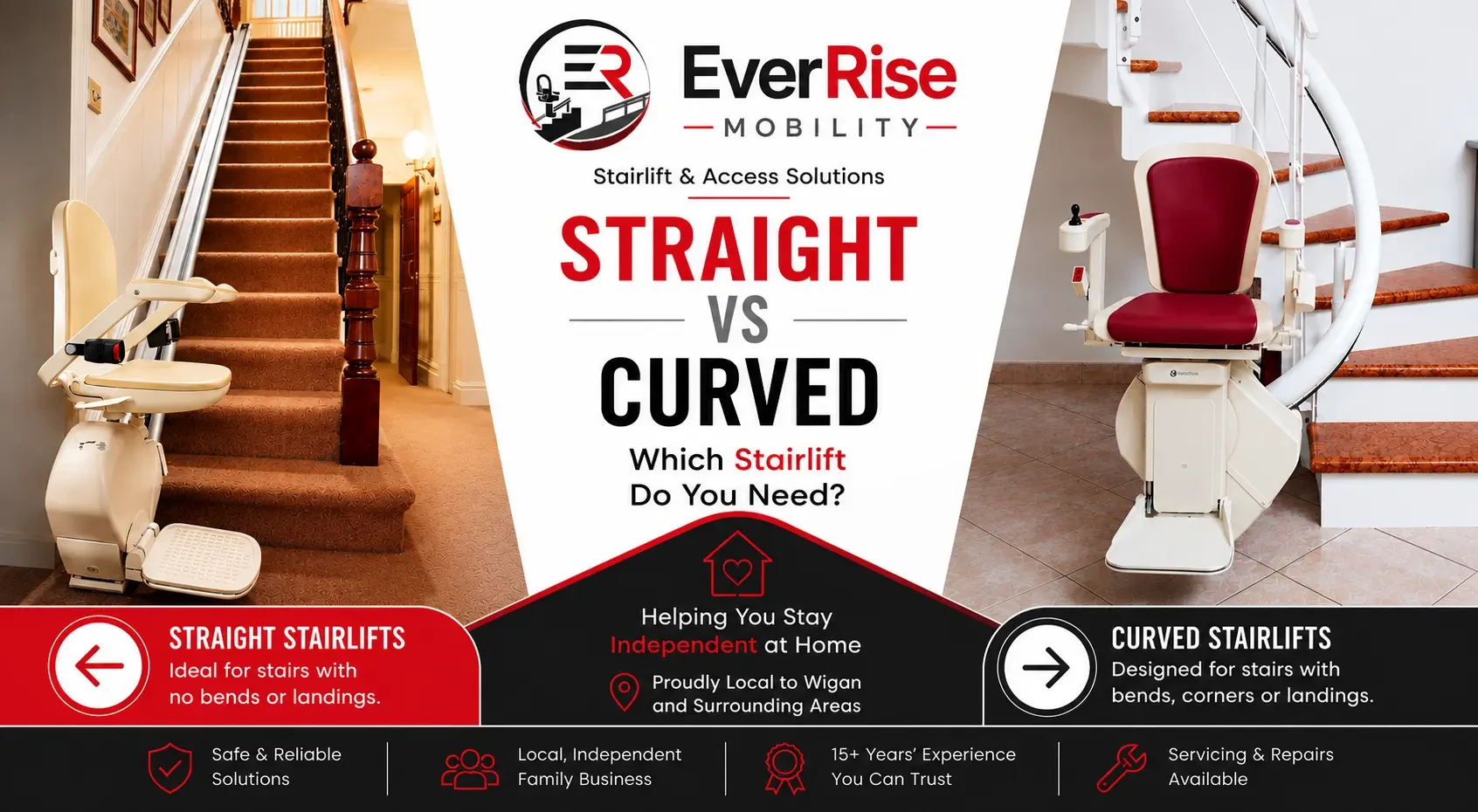
If you're considering having a stairlift installed, one of the first things you'll need to establish is whether you require a straight or curved stairlift.
At first, the difference might sound obvious: straight stairlifts are for straight stairs and curved stairlifts are for curved stairs.
In practice, there's a little more to consider.
The shape of your staircase, landings, doorways, newel posts and the space available at the top and bottom can all influence the type of stairlift and rail configuration that's most suitable for your home.
At EverRise Mobility, we supply and install straight and curved stairlifts throughout Wigan and the surrounding areas. In this guide, we'll explain the main differences and use examples from genuine local installations to show how each type works.
What Is a Straight Stairlift?
A straight stairlift is designed for a staircase that travels in a straight line without bends, corners or intermediate landings.
Because the rail follows one straight flight of stairs, straight stairlifts generally use a standard rail which is cut and configured to suit the length of the staircase.
This makes them relatively straightforward to survey and install.
Straight stairlifts are also generally less expensive than curved stairlifts, largely because unlike a bespoke curved rail, a straight rail doesn't need to be manufactured for the individual staircase.
Does a Straight Staircase Always Mean a Simple Installation?
Not necessarily.
Even when the staircase itself is completely straight, there can be other things to consider.
For example:
- Is there a doorway close to the bottom of the stairs?
- Would the rail create a trip hazard or obstruct a hallway?
- Is there enough room at the top to safely get on and off?
- Is the staircase particularly narrow?
- Are there radiators or other obstructions nearby?
- Would the user benefit from a powered swivel seat or powered footrest?
This is why we recommend assessing the complete staircase and surrounding area rather than simply measuring the length of the stairs.
A Straight Stairlift Installation in Orrell, Wigan
A good example is this Brooks 130 straight stairlift installed by EverRise Mobility in Orrell, Wigan.
The staircase itself was straight, so a straight stairlift was suitable. However, the space at the bottom of the stairs meant that leaving a conventional fixed rail extending into the area wasn't the ideal solution.
A powered hinged rail was therefore fitted.
When required, the lower section of rail can fold away, helping to keep the area at the bottom of the staircase clear.
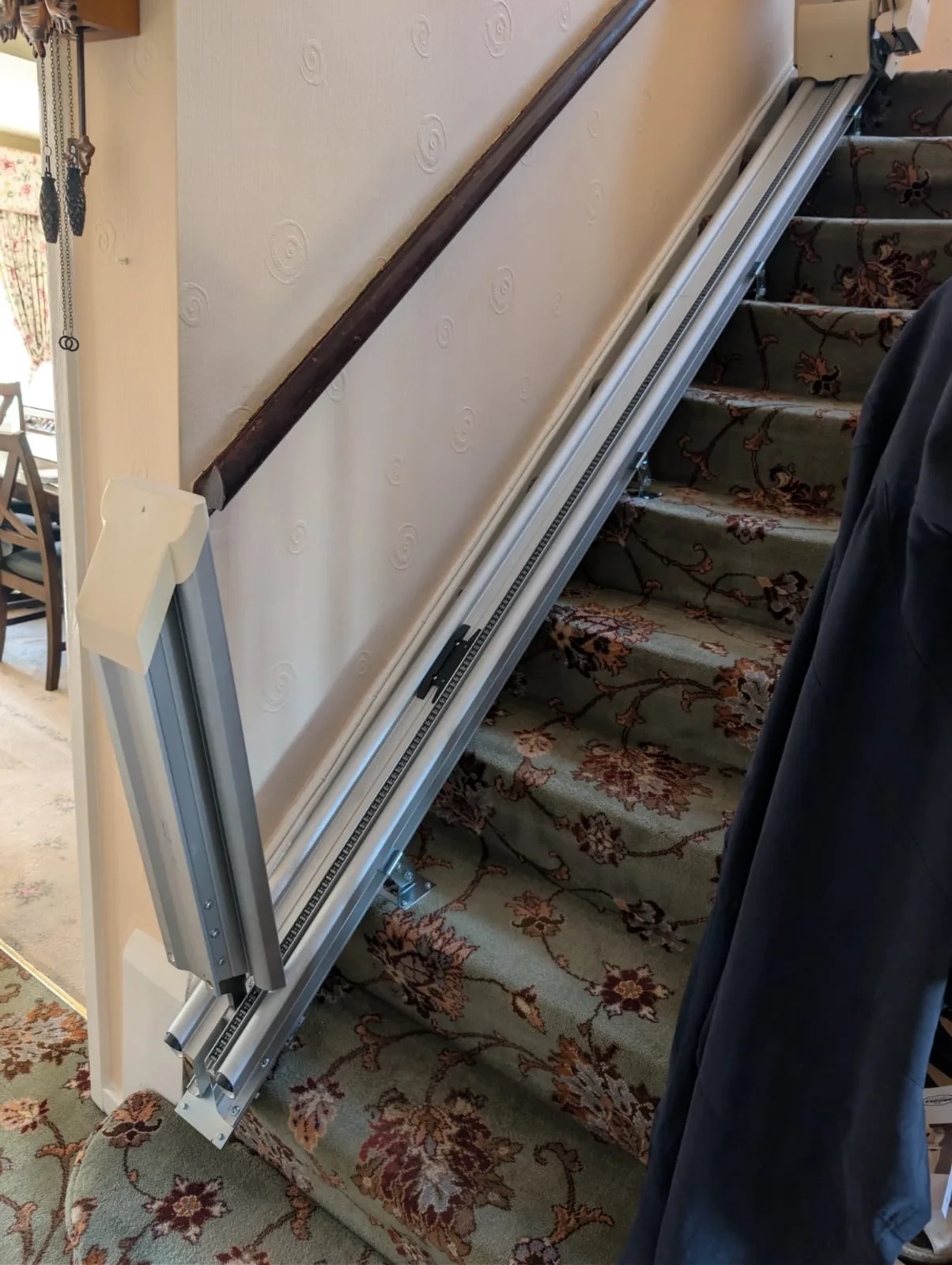
This demonstrates an important point: needing an additional rail feature doesn't necessarily mean you need a curved stairlift.
Straight stairlifts can be available with options designed to overcome particular obstacles around an otherwise straight staircase.
What Is a Curved Stairlift?
A curved stairlift is designed for a staircase where the rail needs to travel around bends, corners or intermediate landings.
Rather than using a standard straight rail, the rail is configured to follow the individual shape of the staircase.
Depending on the property, this could mean travelling:
- Around a single corner
- Around one or more newel posts
- Across an intermediate landing
- Around several bends
- Through changes in the angle of the staircase
- Onto or around the upper landing
Modern curved stairlift systems can accommodate a wide variety of staircase layouts.
Because the rail is made to suit the individual staircase, an accurate survey is particularly important.
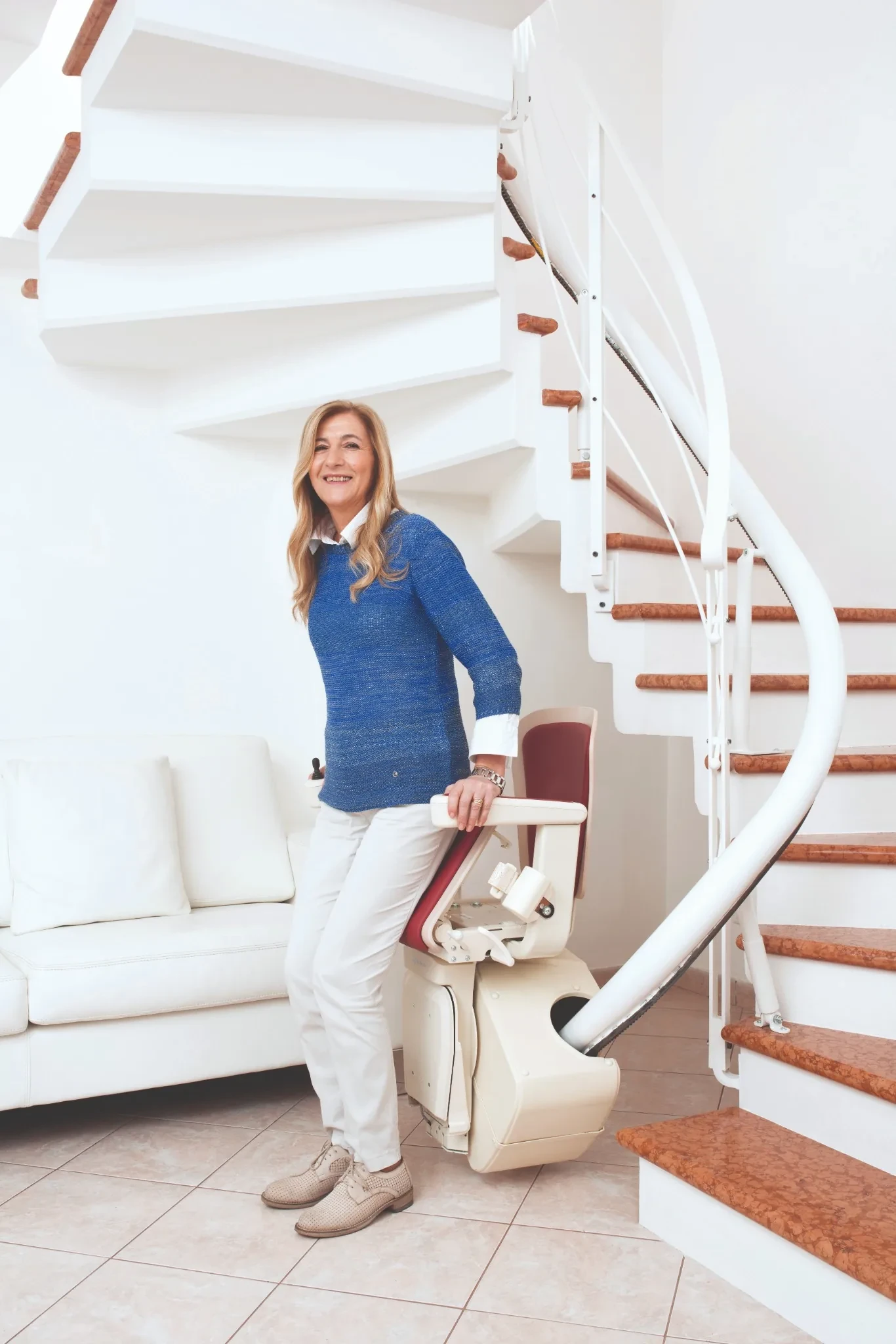
A Real Curved Stairlift Installation in Swinley, Wigan
This Handicare 4000 twin rail curved stairlift was installed by EverRise Mobility in Swinley, Wigan.
It's a good example of why a curved stairlift was required.
At the bottom of the staircase, the rail curves closely around the newel post before following the staircase upwards. This particular case required some additional joinery adjustments to be made to the newel post as it was too narrow to allow proper knee clearance when seated on the lift.

At the top, the rail follows another curve around the upper newel post to provide the appropriate finishing position.
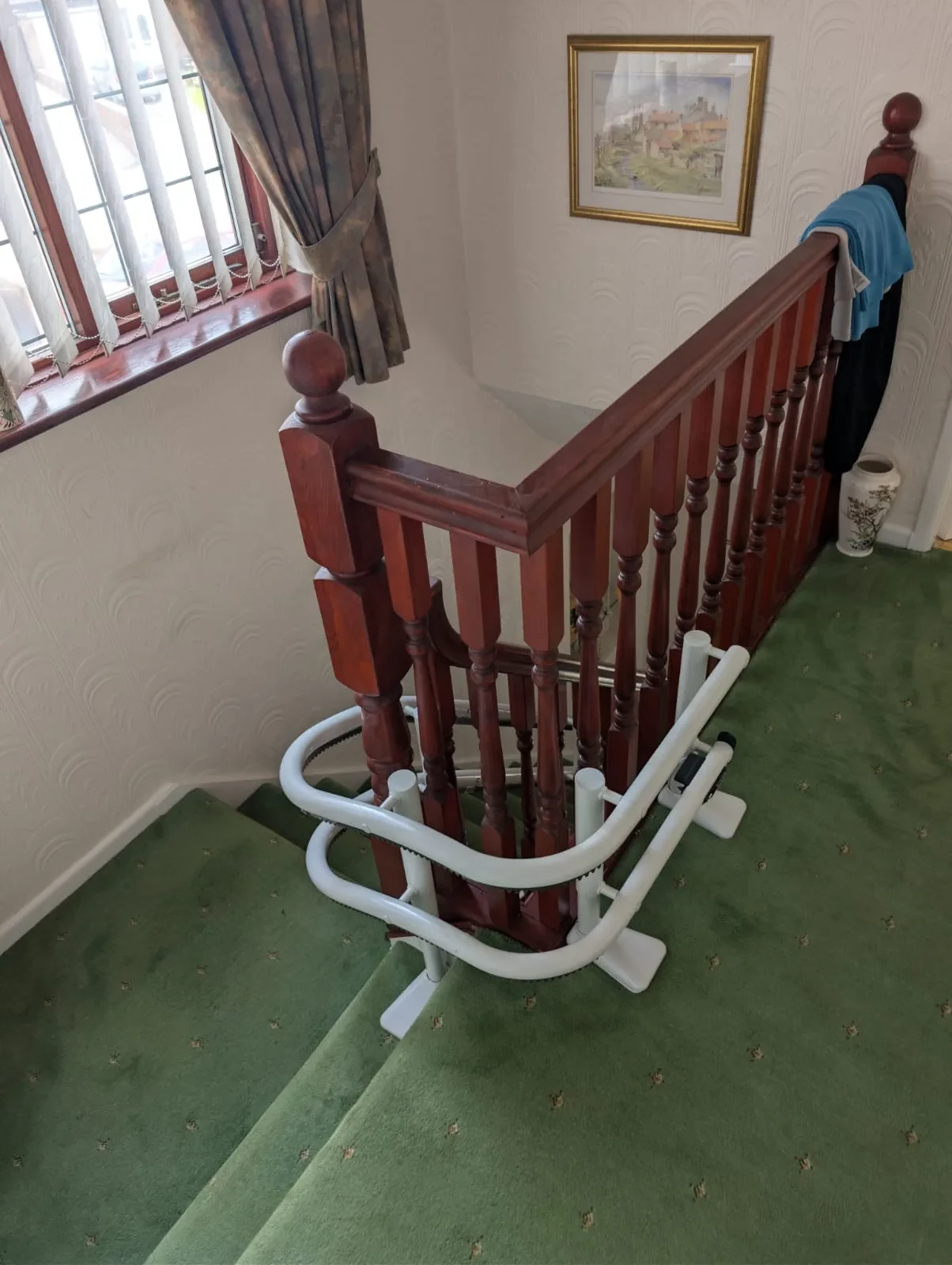
This simply couldn't be achieved with a conventional straight stairlift rail.
The Handicare 4000 uses a custom-built twin rail system designed to accommodate curved staircases and tight bends. You can watch a demonstration of the Handicare 4000 twin rail system in our stairlift video library.

You can see further details and photographs from this and other genuine EverRise Mobility installations in our Projects section.
What If My Staircase Has Two Straight Flights with a Landing?
This is where people can understandably become confused.
You may have two perfectly straight flights of stairs but a landing between them where the staircase changes direction.
If you want one stairlift to travel continuously from the bottom to the top, it will normally require a curved rail to negotiate that change of direction.
However, depending on the staircase, the user and the landing, there may occasionally be other options worth considering.
For example, it may sometimes be possible to install two separate straight stairlifts, one on each flight.
That isn't automatically the best or cheapest solution.
The user would need to transfer from one stairlift to the other at the intermediate landing, so their mobility and ability to transfer safely would be an important consideration.
A home survey allows the different possibilities to be assessed properly.
Straight vs Curved Stairlift – What's the Difference?
The biggest difference is the rail.
A straight stairlift travels along a straight rail designed for a single straight flight.
A curved stairlift travels along a rail made to follow the shape and turns of a particular staircase.
That difference affects several other things.
Cost
Straight stairlifts are generally less expensive.
Curved stairlifts tend to cost more because the rail needs to be designed and manufactured for the individual staircase.
The complexity, length and number of bends can also influence the final price. For a full breakdown of what affects stairlift costs, see our guide How Much Does a Stairlift Cost in 2026?
Survey
Both types should be properly assessed before installation.
For a curved stairlift, however, particularly accurate measurements are required so that the rail can be manufactured to fit the staircase correctly. EverRise Mobility uses advanced 3D photographic surveying software to accurately measure your staircase and surrounding obstacles. This allows us to plan the rail to a very high degree of accuracy and even produce 3D representations showing how the proposed stairlift will travel around your staircase. You can see how Handicare's 4D photo survey technology works in our stairlift video library.
Installation and Lead Time
Straight stairlifts generally have a shorter supply and installation process because a bespoke curved rail doesn't need to be manufactured.
Curved stairlifts can take longer because of the additional design and manufacturing involved.
Reconditioned Options
Reconditioned straight stairlifts can often provide a cost-effective alternative to purchasing new equipment because straight rails can be adapted to suit different straight staircases.
Reconditioned curved stairlifts require more consideration because the rail has been designed around a particular staircase. Availability and suitability therefore depend on the equipment and rail system involved.
Are Curved Stairlifts Always More Expensive?
Generally, yes – but it's worth understanding why.
You aren't simply paying for a stairlift that can turn a corner.
A curved system requires a rail designed around the staircase, taking account of its dimensions, angles, bends and the required start and finishing positions.
The final cost can therefore depend on factors including:
- Length of the rail
- Number of bends
- Staircase configuration
- Parking position
- Rail finish
- Powered options
- Seat specification
- User requirements
That's why it's difficult to provide an accurate curved stairlift quotation without first assessing the staircase.
For a more detailed explanation of stairlift pricing, see our guide How Much Does a Stairlift Cost in 2026?
Can a Curved Stairlift Fit a Narrow Staircase?
Potentially, yes.
Having a curved or narrow staircase doesn't automatically mean a stairlift cannot be installed.
Different rail systems and seat configurations can make better use of the available space.
For example, some curved systems are designed to negotiate particularly tight bends, while options such as powered swivel seats, folding footrests and alternative seating arrangements may help where space is restricted.
The important consideration isn't simply the width of the staircase.
The person using the stairlift needs adequate clearance while travelling, and there also needs to be an appropriate position for safely getting on and off.
This is another area where an on-site assessment is particularly useful.
How Do I Know Which Stairlift I Need?
As a simple starting point:
- If your staircase runs directly from bottom to top without turning, you'll usually need a straight stairlift.
- If the stairlift needs to travel around a corner, bend or intermediate landing, you'll usually need a curved stairlift.
But the staircase is only part of the assessment.
The stairlift also needs to be suitable for the person who will actually use it.
We consider things such as the user's mobility, ability to transfer, available space, staircase configuration and any obstacles around the stairs before recommending a solution.
Do I Need a Home Survey?
We would recommend one.
A home survey allows the staircase to be measured properly and gives us an opportunity to identify potential issues before recommending equipment.
It also means we can discuss the options with you in your own home and explain the advantages and disadvantages of different solutions.
At EverRise Mobility, our home surveys are free and without obligation.
Our aim isn't to sell you the most expensive stairlift.
It's to find a practical solution that works for you, your staircase and your home.
Straight & Curved Stairlifts in Wigan and Surrounding Areas
EverRise Mobility supplies and installs new and reconditioned stairlifts throughout Wigan and surrounding areas, including Orrell, Standish, Leigh, Chorley and Warrington.
We work with established stairlift manufacturers including Brooks, Handicare and Acorn, and with more than 15 years' experience in the mobility industry, we can advise on solutions for both straightforward and more complicated staircases.
We also provide ongoing stairlift servicing and repairs, so our support doesn't have to end once your stairlift has been installed.
Not Sure Whether You Need a Straight or Curved Stairlift?
You don't need to work it out yourself.
If you're considering a stairlift for yourself or a family member, EverRise Mobility can assess your staircase and explain the suitable options without obligation.
Contact EverRise Mobility today to arrange your free home survey and no-obligation quotation.